worksecure.be
EN

Knowledge platform for safety, health and sustainability at work
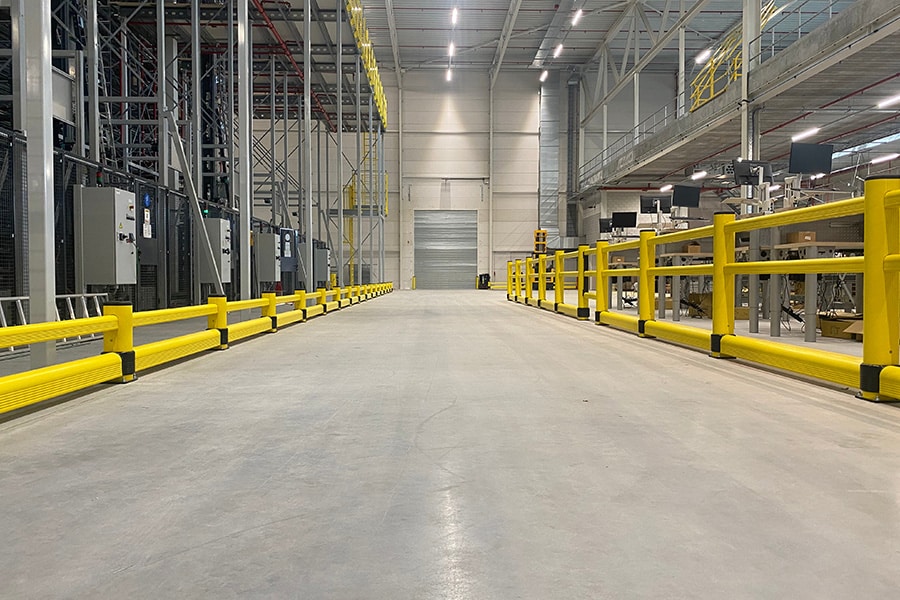
With a new distribution centre in Almere, Hunkemöller has all the space it needs to realise its ambitious growth plans. The move to this building has not only brought more efficiency, but also greater safety risks due to the increase with automation. With Flexbarrier's collision protection, the lingerie brand has been able to minimise the risk of damage and accidents for internal traffic and pedestrians. Health & Safety officer Lisanne Gottmer-Zeldenrijk: “All employees can now walk to their workplace safely.”
Since autumn 2024, Hunkemöller's shops will receive their products from Almere. There, the lingerie manufacturer has built a modern distribution centre of over 19,000 square metres. Every day, around 150 employees - rising to 250 in the high season - are busy processing the orders of more than 900 shops from 19 countries. Two automation systems help them: a large part of the stock is held in a miniload system with six cranes, while a robot system has been installed on one of the mezzanines. That system has one hundred robots constantly moving to bring the mobile racks with picking stock to the order pickers.
The move to Almere represented a big step for employees. For decades, Hunkemöller operated from a warehouse in the middle of Hilversum, which had become too small. “The safety risk was a lot lower there because we did everything manually. The order pickers went on foot with their trolleys along the shelf racks. For internal transport, we only used hand pallet trucks. The only mechanisation consisted of a single roller conveyor,” says Gottmer-Zeldenrijk. “Now, suddenly, we are working in a large distribution centre with reach trucks and electric pallet trucks, where collision protection and a traffic plan are needed to manage transport.”
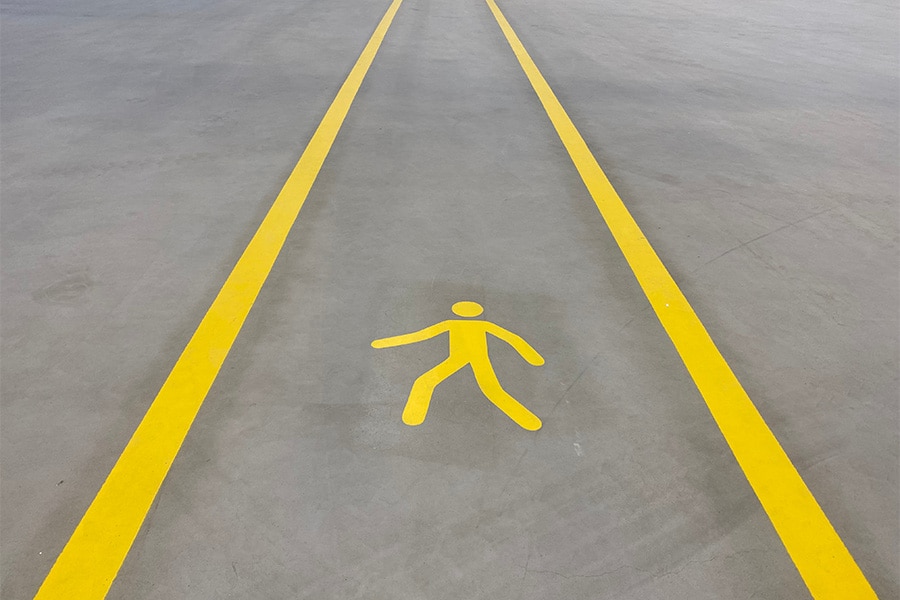
A busy distribution centre requires good collision protection to protect employees and prevent damage. “In such a large hall, we have to ensure that all employees can walk safely to their workstations and that they can work there safely. That is why we installed driving paths and walkways on the floor, which we separated as much as possible with a pedestrian barrier. Where this was not possible, the agreement applies that pedestrians always have priority over moving equipment.”
The pedestrian barrier consists of a fence with rails at hip and knee height. “With an additional rail at floor level that protects employees” ankles from the ladles of the moving equipment. After all, employees are trained with the instruction to keep the scoops low while driving,“ says Gottmer-Zeldenrijk. ”Employees should always walk behind the barrier. At the entrance, we have therefore fenced off an extra large part of the floor, so that employees are also safely behind the fence during day start and toolbox meetings."
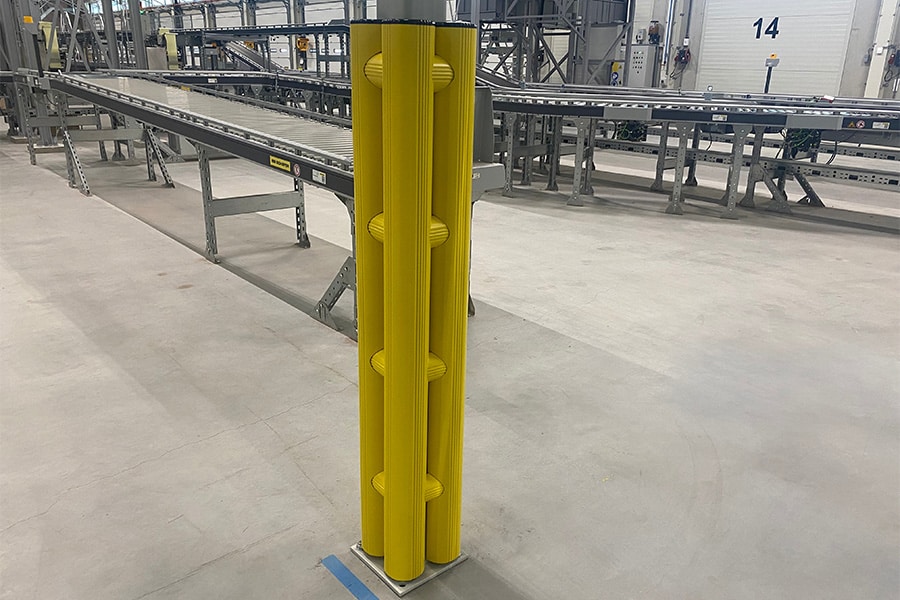
To prevent damage to the building's columns, Hunkemöller shielded part of them with a HUG TOWER. “In places where the very highest protection is needed for the building and equipment, we installed sturdy fencing to prevent reach trucks and electric pallet trucks from getting close. We also protected the mezzanine, goods lift, sorting plant and other crucial installations. We also added additional crash protection to the fence around the mini-load system, so that the cranes are not at any risk.”
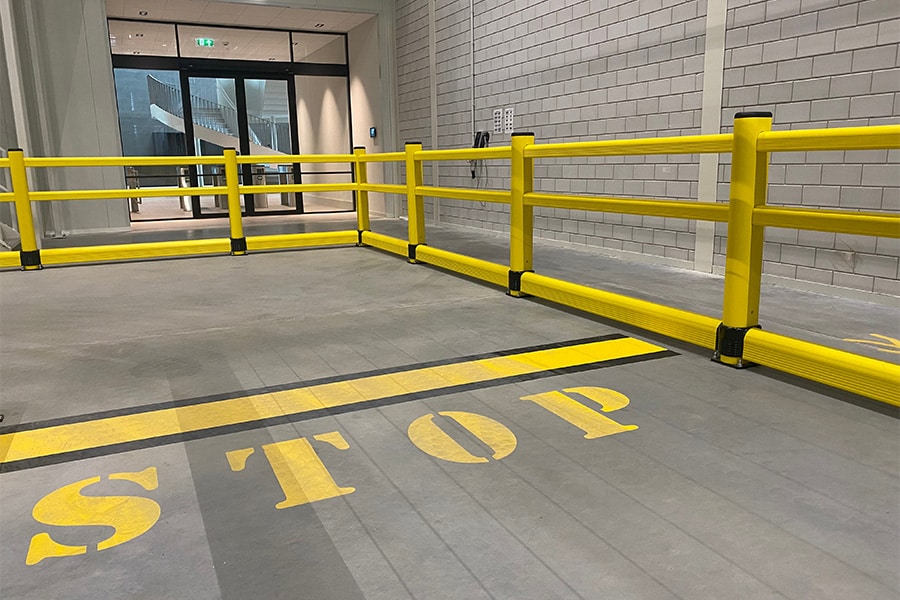
All crash protection, lines and floor stickers were supplied and applied or installed by Flexbarrier. This supplier was preferred by Hunkemöller after a comparison. “We wrote to several parties and finally asked two suppliers for quotations. We compared them not only on price, but also on quality and sustainability. What also played a role was the short delivery time. Flexbarrier was flexible in all respects and continually thought along with us. The cooperation with contractor Burgland Bouw and architectural and engineering firm Sweco was excellent.”
The collision protection itself is also extremely flexible due to its modular design. “We have built this distribution centre with the future in mind. If we want to change the layout and processes, we can dismantle Flexbarrier's products and reinstall them elsewhere. Possibly with another post in it or an extra fence in between. This is very important to us, because Hunkemöller keeps moving. Also in this distribution centre.”
Visitors to hot distribution centre were also surprised by the collision protection. When inspecting the electrical installations, for example, an inspector objected because the switch boxes of the mini-load system could not be opened. This was because collision protection had been installed right in front of the cabinets. “We then showed that loosening a bolt with an Allen key is sufficient to loosen the guardrail and slide it off the base plate. With this solution, the switch boxes are well protected, but we can still open them quickly if needed. We use the same solution to give service engineers access to the mini-load system.”
The installation of all collision protection went smoothly. Occasionally, the mechanics encountered an unexpected problem, such as when they could not drill deep enough to anchor a column protector in the floor. Thanks to the creativity and flexibility of the assembly crew, they managed to solve these problems without compromising on workplace safety. “It was a relief that we didn't have to think about this ourselves,” he says.”
That the collision protection works has now been experienced by Hunkemöller. “Work in a distribution centre like this remains human work,” explains Gottmer-Zeldenrijk. “The crash protection has shown to work as promised: after a minor collision with a HUG TOWER, neither the floor nor the vehicle had any damage. Only the collision protection itself showed some marks. It absorbed the impact and thus did exactly what it was supposed to do.”